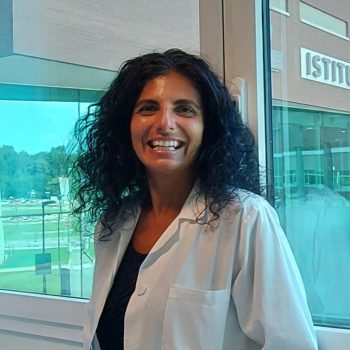
Principal Investigator
Staff
Research topic
Our current research interests intersect epigenetics, tumor genomics, and precision oncology for hard-to-treat solid tumors, including metastatic colorectal cancer, pleural mesothelioma and pancreatic cancer.
Background
My research interests have always been inspired by the observation that the ‘one-size-fits-all’ approach should not be applied to treat cancers of the same histological type; since tumors affecting the same tissue often display individual and peculiar morphological and molecular features. My studies on the molecular mechanisms of cell transformation have been consistently aimed at identifying individualized targets amenable for therapeutic intervention as well as cancer prognostic and/or predictive biomarkers. Throughout my career, I have shown that it is possible to deliver precision cancer medicine by coupling tumor molecular profiling with functional studies in clinically relevant preclinical models.
Research achievements
Throughout my career I have demonstrated an established record of accomplishments in the field of translational oncology.
I contributed to establish that activated RAS-BRAF signalling can by-pass EGFR targeted inhibition in metastatic colorectal cancer, a notion that led to restricting the use of EGFR targeted monoclonal antibodies to RAS wild-type metastatic colorectal cancer patients. In this regard, I am the leading author of a highly cited manuscript that first described BRAF V600E mutations as a biomarker of adverse prognosis and of resistance to EGFR targeted therapies in metastatic colorectal cancer patients.
In the same field, I contributed as a co-first author to the discovery that lack of efficacy of BRAF inhibitors could be mediated by feedback re-activation EGFR in colon tumors, and proved that combinations of EGFR and BRAF inhibitors were effective in restraining growth of BRAF mutant colorectal cancer xenografts. Importantly, my preclinical works have also provided the rationale for the design of clinical trials testing BRAF and EGFR inhibitor combinations in BRAF mutant metastatic colorectal cancer patients, a regimen that is now clinically approved. My laboratory has then further shown that it possible to individualize treatment of BRAF mutant metastatic colorectal cancer patients, by studying mechanisms of primary and acquired resistance to molecularly targeted agents in tumor samples as well as in liquid biopsies.
Finally, we have developed an interest in epigenetics of colorectal cancer, since methylation changes can serve as tumor-specific changes for monitoring tumor burden in plasma circulating tumor DNA, as well as modifiers of drug response. In this regard, my team has implemented a digital PCR based assay to provide a quantitative assessment of MGMT methylation in tissue and liquid biopsies for prediction of response to alkylating agents in advanced CRC patients. Along this research topic, we have also completed genome-wide assessment of DNA methylation of a collection of over 200 colorectal cancer cell lines and compared it to normal mucosa and blood cells, in order to define a highly specific and sensitive gene methylation signature to be employed in liquid biopsy tests. We have evidence that assessment of methylated markers in cell-free circulating DNA allows non-invasive monitoring of disease burden in metastatic colorectal cancer patients. Methylation changes over time correlate with tumor response evaluated by CT-scan in patients treated with chemotherapy or targeted agents
Conclusions and perspectives
Current research projects are investigating:
The molecular bases of liquid biopsy tests for precision oncology.
The interplay between metabolism / microenvironment and epigenetics in colorectal, pancreatic and gastric tumors;
Tumor evolution under therapy;
Publications
At this link, you can find all the scientific publications of the Principal Investigator.
Selected Publication
Pessei V, et al., Genome Med. 2024 Oct 9;16(1):118.
Maione F, et al., Mol Oncol. 2024 Jun;18(6):1552-1570.
Di Nicolantonio F, et al, Nat Rev Clin Oncol. 2021 Aug;18(8):506-525.
Magrì A., et al., Sci Transl Med. 2020 Feb 26;12(532):eaay8707.
Barault L., et al., Gut. 2018 Nov;67(11):1995-2005.